
More than astrophotography, an astronomical exploration.
Never before seen Eta Serpentis and LDN520
David Cruz · Astromidnight
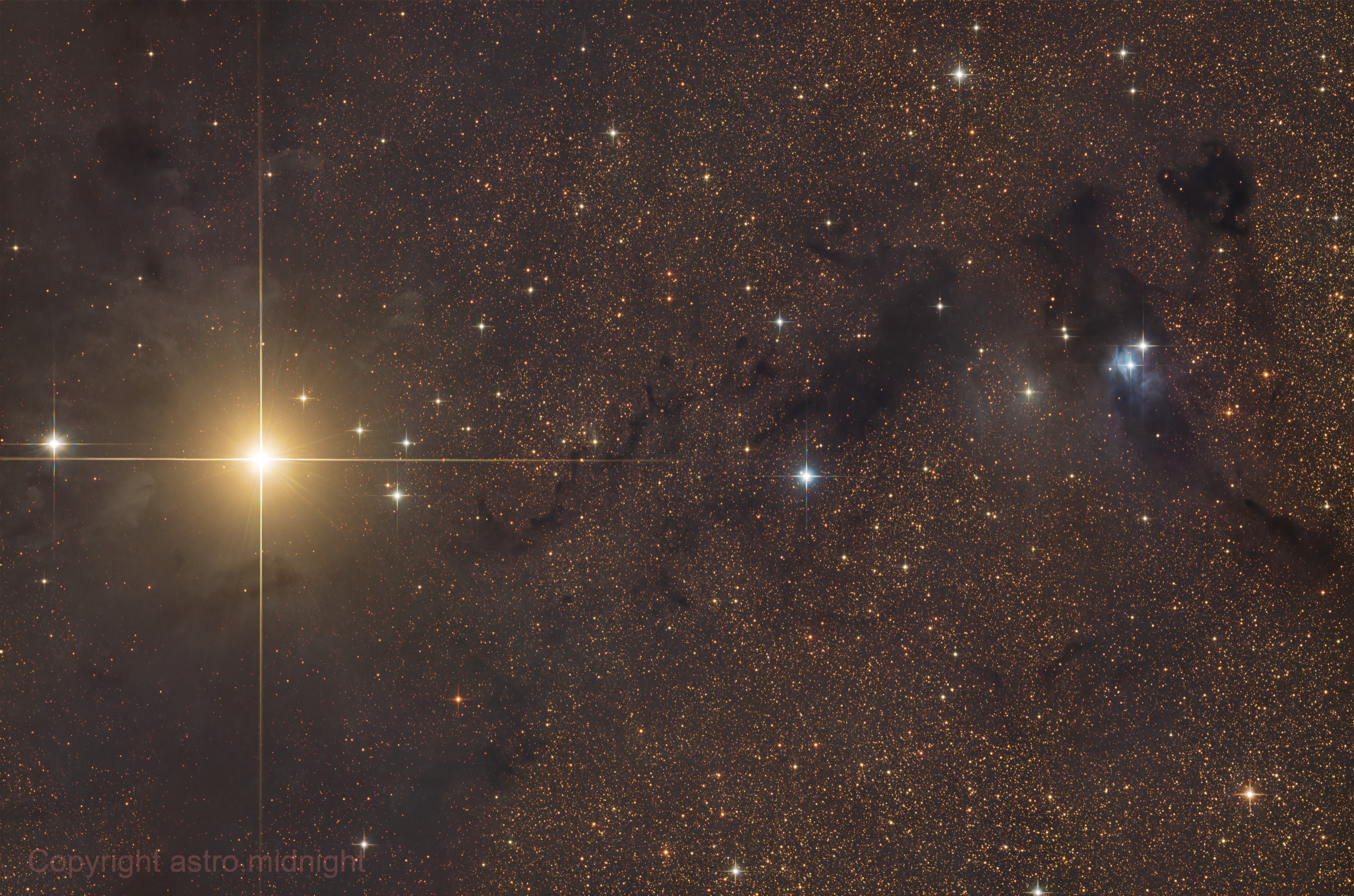
In Serpens Cauda, the orange giant Eta Serpentis shines just 62 light-years away, far in front of the dust clouds of LDN 520. Farther off, dark filaments of the Aquila Rift blot out the stars of the Milky Way.
| Catalogue | Bayer, 1603 · 58 Ser · HR 6869 |
| Type | Giant star and dark nebula |
| Distance | ≈ 62 light-years (η Ser) |
| Field | 80.4′ × 53.3′ |
| Scale | 0.78″ / pixel |
| Orientation | 88° · east up |
| RA (centre) | 18h 21m 17s |
| DEC (centre) | −02° 29′ 32″ |
| Constellation | Serpens |
| Objects in field | η Ser · LDN 520 · 1 reflection nebula · GJ 710 |
Star distances from Gaia parallax (SIMBAD). The distance of LDN 520 is not published; the distance of the Aquila Rift and Serpens region is debated, between about 260 and 415 parsecs (Nakamura et al. 2017). No real width: the stars are much closer than the clouds. Positions of η Ser and LDN 520 taken from the AstroBin astrometric solution (that of the nebula is approximate); the others from SIMBAD.
13 h 20 min of light
Each tick is a 240-second exposure. 200 in total, with the camera at −10 °C and gain 100. Calibrated with 50 darks, 50 flats and 50 bias. The Moon stayed below 70 % illumination throughout.
Carbon Newton 10' f/4
ZWO ASI2600MC Pro
Sky-Watcher CQ350 Pro
Askar M54 OAG · ZWO ASI120MM Mini
TS-Optics NEWTON Coma Corrector 1.0x (TSGPU)
Adobe Photoshop · Pleiades Astrophoto PixInsight · Stefan Berg Nighttime Imaging 'N' Astronomy (N.I.N.A. / NINA)
São Pedro da Gafanhoeira, Évora · 358 m
Bortle 3