
More than astrophotography, an astronomical exploration.
Dusty Pacman (NGC 281)
David Cruz · Astromidnight
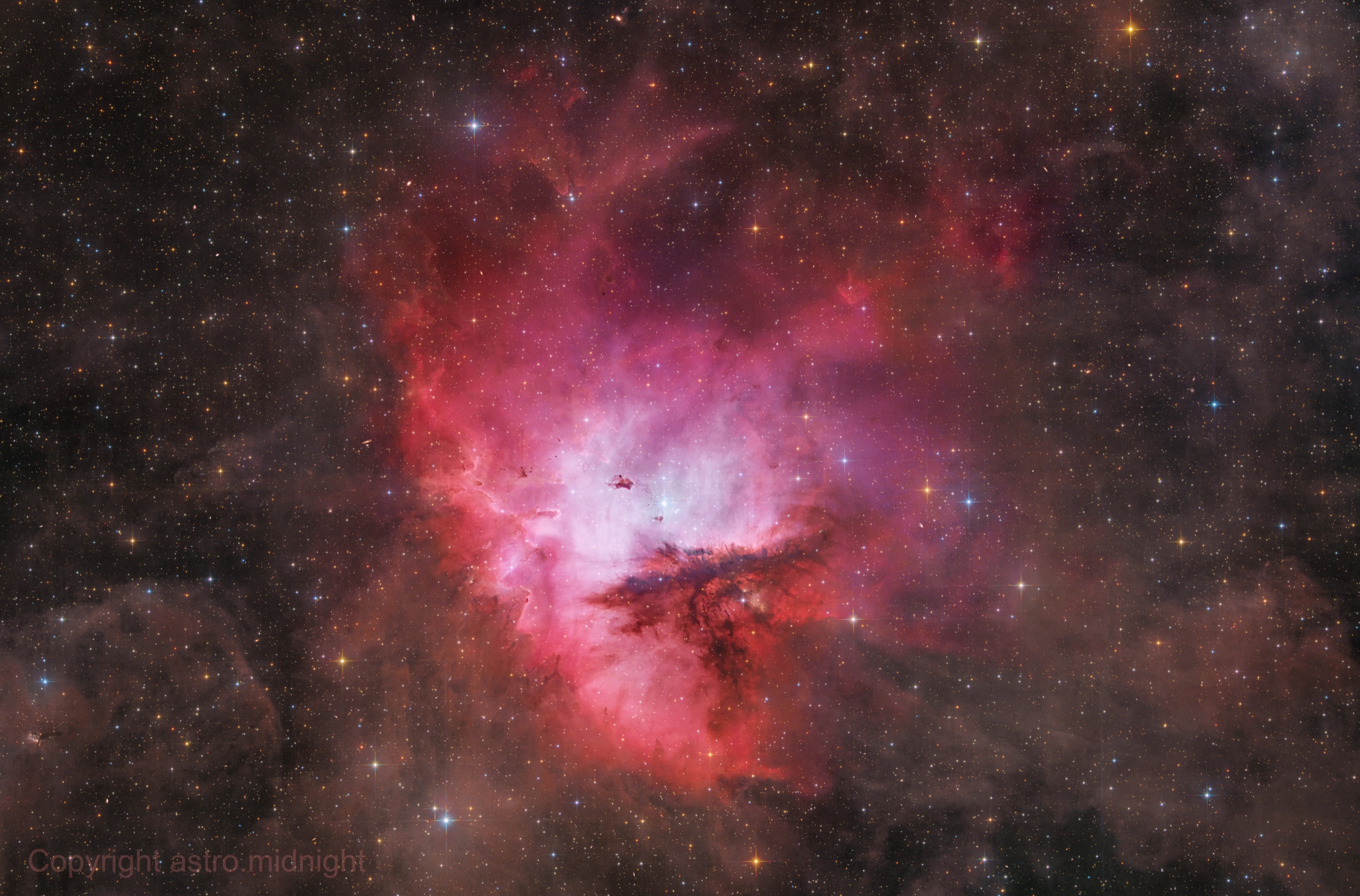
In Cassiopeia, the Pacman Nebula glows red with gas heated by a cluster of newborn stars. Around it, a vast web of dust that is rarely seen.
| Catalogue | NGC 281 · Sh2-184 · LBN 616 |
| Type | Emission nebula |
| Distance | ≈ 9,200 light-years |
| Field | 81.7′ × 53.8′ |
| Real width | ≈ 220 × 145 light-years |
| Scale | 0.54″ / pixel |
| Orientation | −3° · north up |
| RA (centre) | 00h 52m 41s |
| DEC (centre) | +56° 40′ 54″ |
| Constellation | Cassiopeia |
| Objects in field | NGC 281 · IC 1590 · HD 5005 · Bok globules · 2 LBN |
Distance measured from the parallax of a water maser in NGC 281 (Sato et al. 2008, 2.82 kpc); NASA rounds it to about 10,000 light-years. The real width assumes the distance of 9,200 light-years. Positions of the nebulae taken from the AstroBin astrometric solution and approximate; those of the dark cloud and the globules were measured on the image. The distance of LBN 621 has not been published.
14 h 36 min of light
Each tick is a 240-second exposure. 219 in total, with the camera at −10 °C and gain 100. Calibrated with 30 darks, 30 flats and 30 bias. The Moon stayed below 15 % illumination throughout.
Carbon Newton 10' f/4
ZWO ASI2600MC Pro
Sky-Watcher CQ350 Pro
Askar M54 OAG · ZWO ASI120MM Mini
TS-Optics Maxfield .95X Coma Corrector
Adobe Photoshop · Pleiades Astrophoto PixInsight · Stefan Berg Nighttime Imaging 'N' Astronomy (N.I.N.A. / NINA)
São Pedro da Gafanhoeira, Évora · 358 m
Bortle 3