
More than astrophotography, an astronomical exploration.
Comet 220P/McNaught (10 August)
David Cruz · Astromidnight
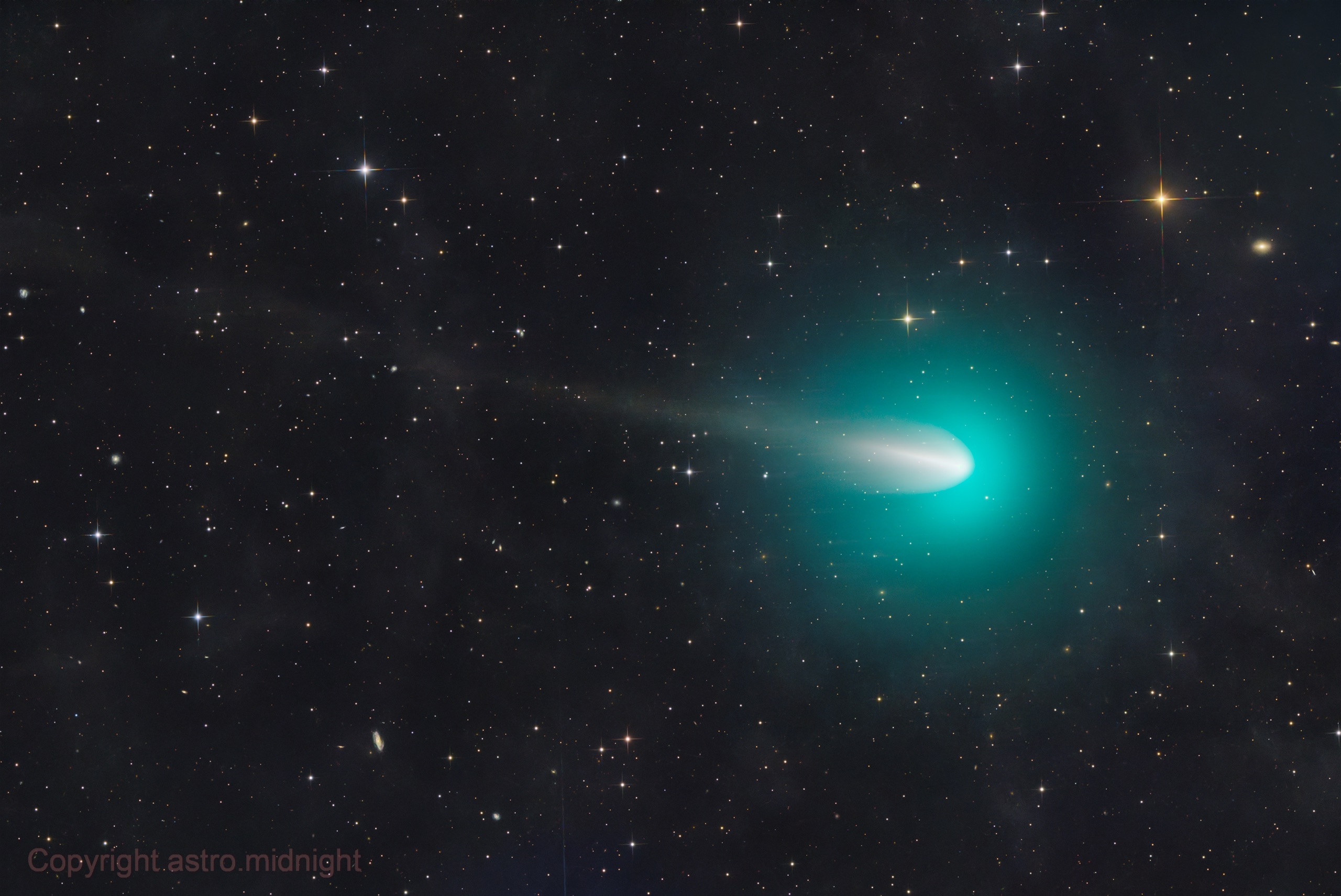
In Cetus, comet 220P/McNaught in full outburst, with its green head and a faint tail. Behind it, dust from our own galaxy and galaxies hundreds of millions of light-years away.
| Catalogue | Periodic comet 220P · discovered in 2004 |
| Type | Jupiter-family comet |
| Distance | ≈ 183 million km (1.22 AU, 10 Aug 2026) |
| Field | 74.1′ × 49.5′ |
| Scale | 1.48″ / pixel |
| Orientation | 176° · south up |
| RA (centre) | 02h 45m 30s |
| DEC (centre) | +09° 30′ 17″ |
| Constellation | Cetus |
| Objects in field | 220P · IC 1849 · UGC 2214 · IFN |
Distance and orbit of the comet calculated by JPL (Horizons and Small-Body Database) for the early hours of 10 August 2026. The position of the comet was measured by us on the image and matches the JPL ephemeris for that night. The outburst is documented by the BAA Comet Section; the factor of 20,000 times quoted in the press is not confirmed by an official source and is not used. Distances of the galaxies calculated from redshift (NED), with H0 = 70 km/s/Mpc. No real width: the field mixes a comet in the Solar System with distant galaxies. The position of the IFN dust is indicative.
3 h 20 min of light
Each tick is a 60-second exposure. 200 in total, with the camera at −10 °C and gain 100. Calibrated with 30 darks, 30 flats and 30 bias. The Moon stayed below 10 % illumination throughout.
Carbon Newton 10' f/4
ZWO ASI2600MC Pro
Twinstar Friction Mount FG80
Askar M54 OAG · ZWO ASI120MM Mini
TS-Optics Maxfield .95X Coma Corrector
Adobe Photoshop · Pleiades Astrophoto PixInsight · Stefan Berg Nighttime Imaging 'N' Astronomy (N.I.N.A. / NINA)
Alentejo - Portugal