
More than astrophotography, an astronomical exploration.
Comet 13P/Olbers
David Cruz · Astromidnight
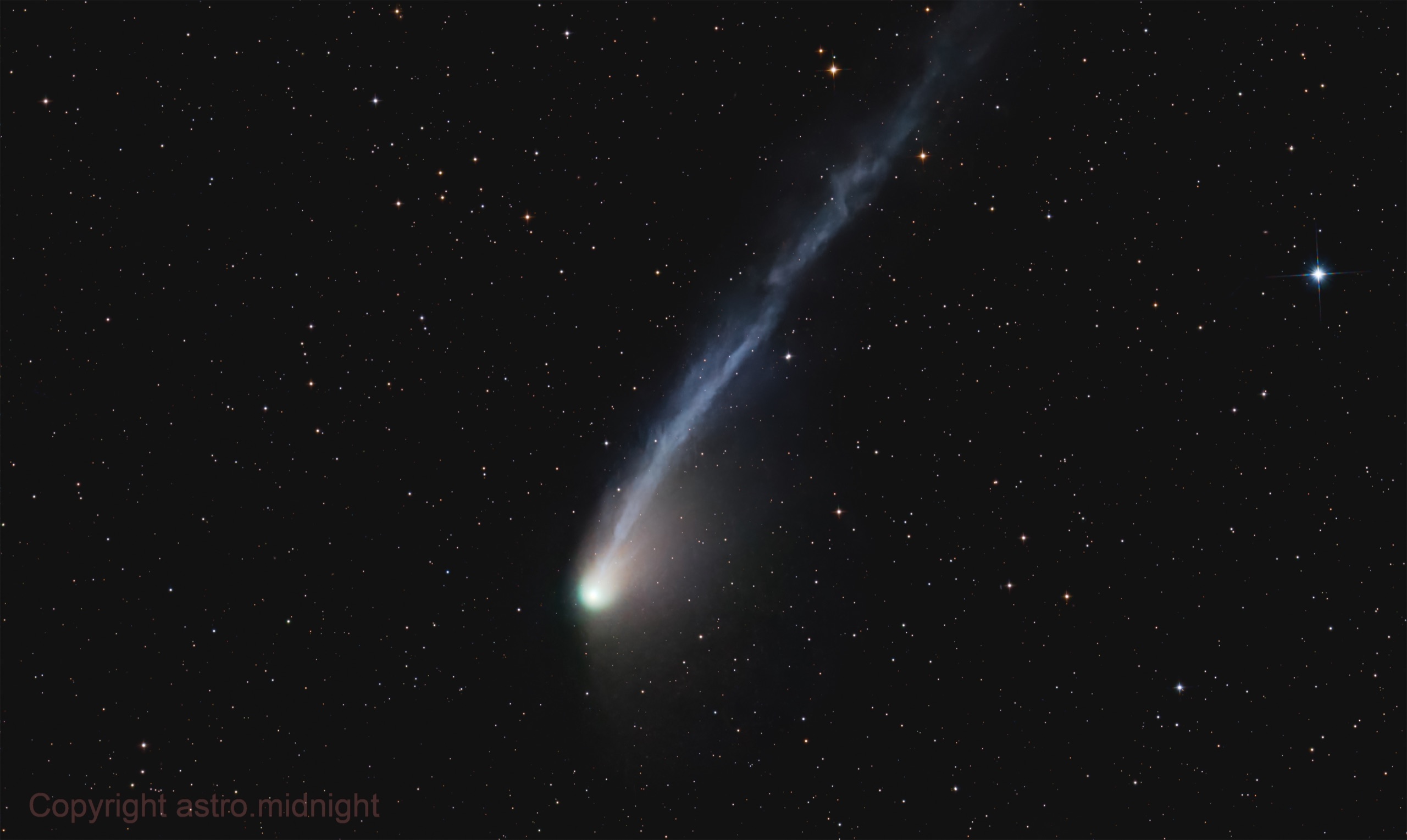
In Lynx, Comet 13P/Olbers on 7 July 2024, a week after passing the Sun, with a green head and a long blue gas tail. It returns every 68 years: its next visit will only come around 2092.
| Catalogue | Comet 13P · discovered by Olbers in 1815 |
| Type | Halley-type comet |
| Distance | ≈ 286 million km (1.91 AU, 7 Jul 2024) |
| Field | 140.8′ × 84.1′ |
| Scale | 1.80″ / pixel |
| Orientation | 86° · east up |
| RA (centre) | 09h 12m 50s |
| DEC (centre) | +42° 10′ 47″ |
| Constellation | Lynx |
| Objects in field | 13P/Olbers · 36 Lyn · Abell 759 · 1 galaxy · 1 quasar |
Orbit and distance of the comet calculated by JPL (Small-Body Database and Horizons) for the night of 7 July 2024, from the Alentejo. The position of the comet's head was measured by us on the image and matches the JPL ephemeris for around 21:30 UT (22:30, Portuguese time), with the comet about 16° above the horizon; it was moving about 1.3 arcminutes every half hour. The gas tail and the dust fan are described in the comet's text, with a single marker on the head. The distance to 36 Lyn comes from parallax (SIMBAD); those to the galaxy and the quasar were calculated from redshift (NED), with H0 = 70 km/s/Mpc. The distance to the Abell 759 cluster is not published. No real width: the field mixes a comet in the Solar System with far more distant stars and galaxies.
0 h 27 min of light
Each tick is a 160-second exposure. 10 in total, with the camera at −10 °C and gain 100. Calibrated with 50 darks, 40 flats and 50 bias. The Moon stayed below 5 % illumination throughout.
TS-Optics 150mm/6" ONTC f/4 Newtonian (carbon tube)
ZWO ASI2600MC Pro
ZWO AM5
ZWO ASI120MM Mini
TS-Optics Maxfield .95X Coma Corrector · ZWO EAF
Adobe Photoshop · Pleiades Astrophoto PixInsight · ZWO ASIAIR
São Pedro da Gafanhoeira, Évora · 358 m
Bortle 3