
More than astrophotography, an astronomical exploration.
Comet 12P/Pons-Brooks
David Cruz · Astromidnight
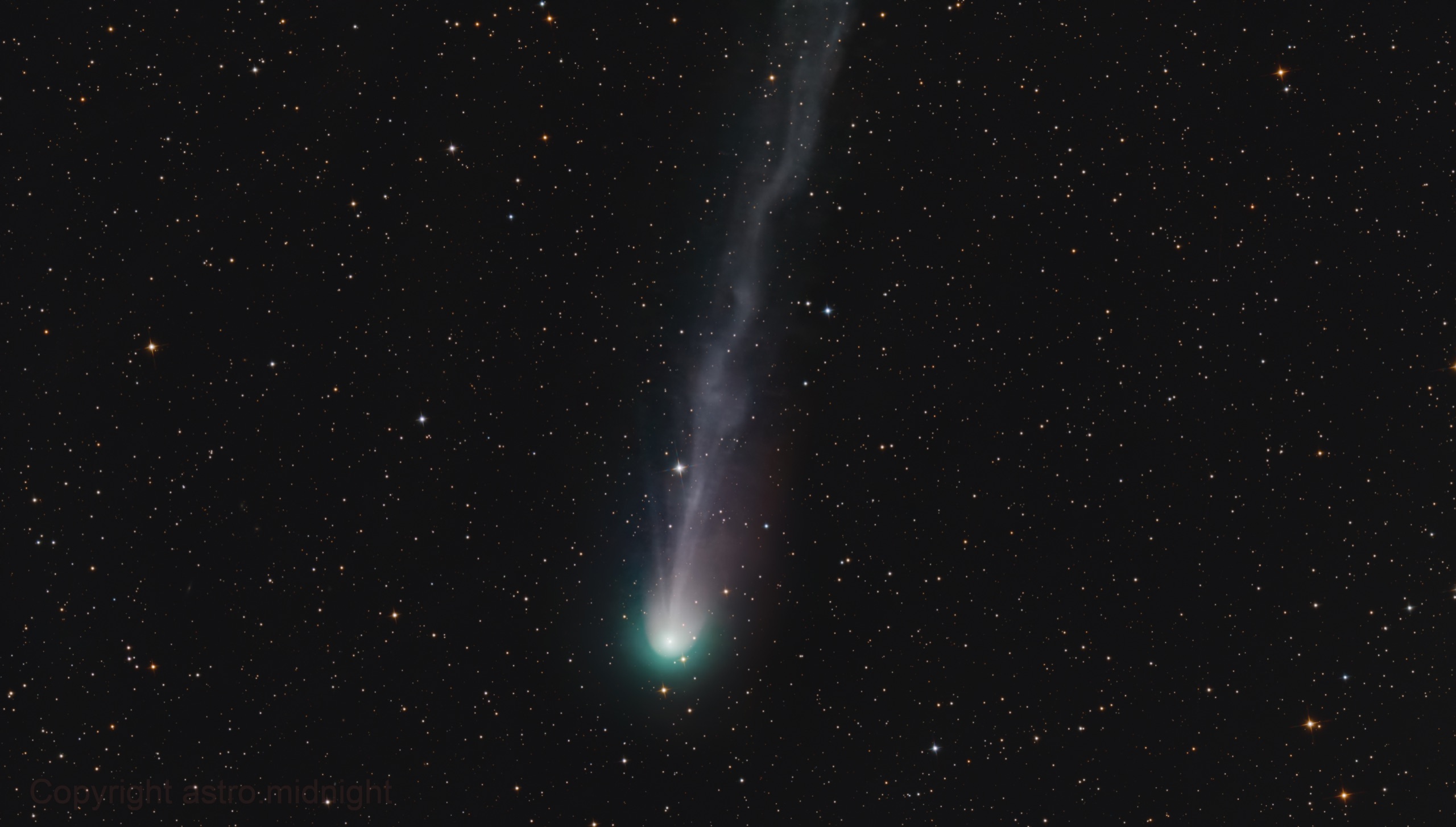
In Andromeda, comet Pons-Brooks seven weeks before perihelion, with a green head and a long gas tail full of ripples. It will only return to our sky around 2095.
| Catalogue | Periodic comet 12P · discovered by Pons in 1812, rediscovered by Brooks in 1883 |
| Type | Halley-type comet |
| Distance | ≈ 250 million km (1.67 AU, 4 Mar 2024) |
| Field | 135.5′ × 76.9′ |
| Scale | 1.35″ / pixel |
| Orientation | 25° · north-east up |
| RA (centre) | 23h 58m 11s |
| DEC (centre) | +35° 07′ 16″ |
| Constellation | Andromeda |
| Objects in field | 12P · IC 5376 · 1 galaxy group and 1 galaxy cluster · 1 quasar · HD 224492 |
Image date according to David's description: 4 March 2024, between 19:30 and 20:30 (Portuguese time, the same as UT on this date). Distances, magnitude and orbit of the comet calculated by JPL (Horizons and Small-Body Database) for that interval; the period of about 71 years is that of the JPL osculating orbit. The position of the comet's head was measured by us in the image: it lies about 2.6 arcminutes south of the path predicted by JPL for that time (the surrounding stars match the catalogue, so the difference probably comes from stacking on the comet; we have not confirmed this). Distances of the galaxies and the quasar calculated from redshift (NED, SIMBAD), with H0 = 70 km/s/Mpc. No real width: the field mixes a comet in the Solar System with distant stars and galaxies.
TS-Optics 150mm/6" ONTC f/4 Newtonian (carbon tube)
ZWO ASI2600MC Pro
ZWO AM5
ZWO ASI120MM Mini
TS-Optics Maxfield .95X Coma Corrector · ZWO EAF
Adobe Photoshop · Pleiades Astrophoto PixInsight · ZWO ASIAIR
São Pedro da Gafanhoeira, Évora · 358 m
Bortle 3