
More than astrophotography, an astronomical exploration.
A deeper look at the Cave
David Cruz · Astromidnight
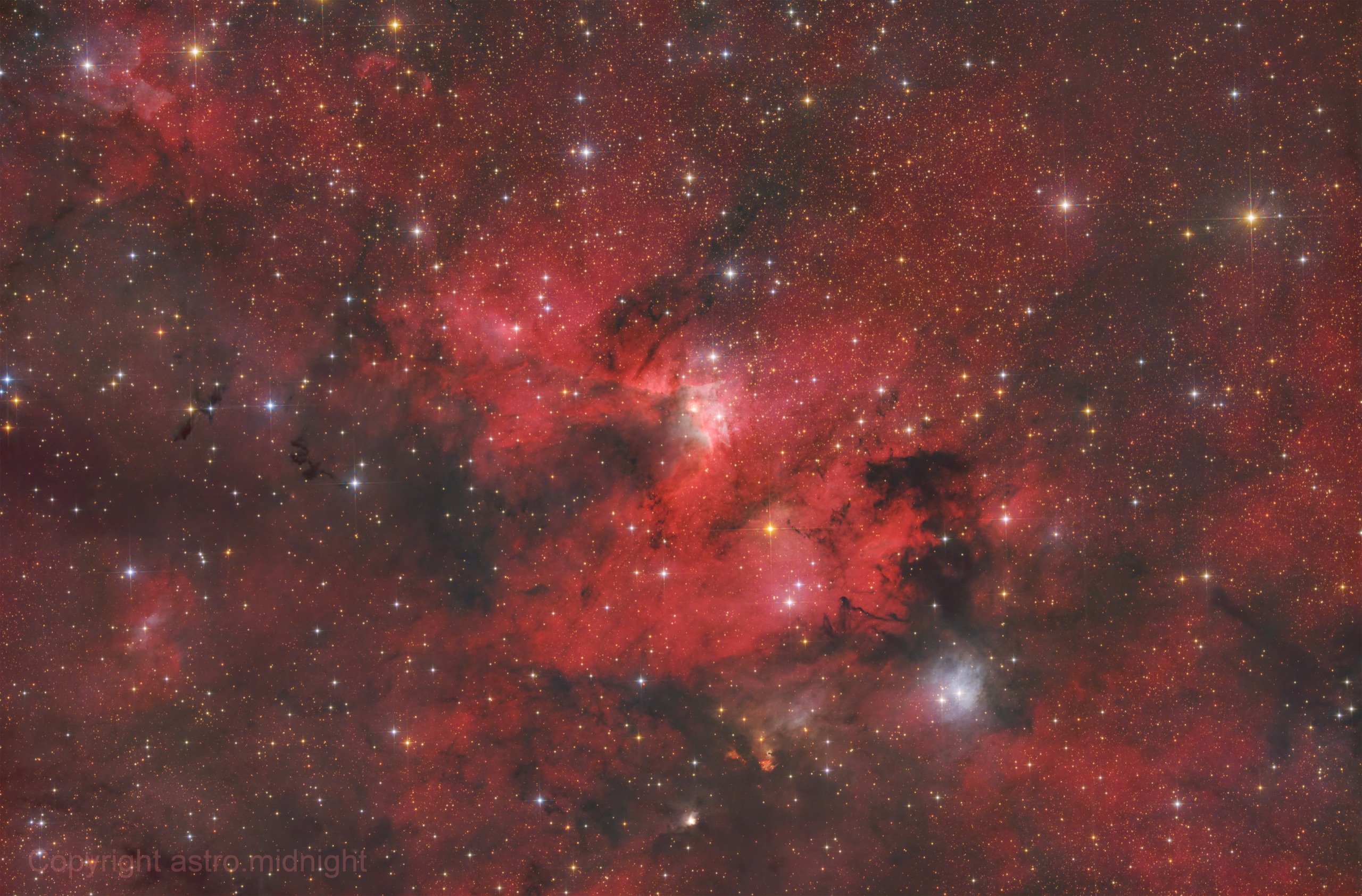
In Cepheus, the Cave Nebula opens where the light of young, hot stars eats into the edge of a molecular cloud. Around it, dark dust, blue reflections and Cepheus A, a cradle of high-mass stars.
| Catalogue | Sharpless, 1959 · LBN 529 |
| Type | Emission nebula (HII region) |
| Distance | ≈ 2,400 light-years |
| Field | 138.7′ × 91.3′ |
| Real width | ≈ 97 × 64 light-years |
| Scale | 1.35″ / pixel |
| Orientation | −1° · north up |
| RA (centre) | 22h 57m 17s |
| DEC (centre) | +62° 34′ 19″ |
| Constellation | Cepheus |
| Objects in field | Sh2-155 · Cep A · vdB 155 · V733 Cep · 5 LDN |
Distance of the Cave according to NASA (APOD, 2014); the Gaia parallax of the Cep OB3 stars in the field points to ≈ 2,700 light-years, and Cepheus A is at ≈ 2,300 light-years (VLBA parallax). The real width assumes 2,400 light-years. Positions from SIMBAD; those of the dark and bright nebulae are approximate.
34 h 52 min of light
Each tick is one exposure. 473 in total, with the camera at −10 °C and gain 100. Calibrated with 50 darks, 50 flats and 50 bias. The Moon stayed below 40 % illumination throughout.
TS-Optics 150mm/6" ONTC f/4 Newtonian (carbon tube)
ZWO ASI2600MC Pro
ZWO AM5
ZWO ASI120MM Mini
TS-Optics Maxfield .95X Coma Corrector · ZWO EAF
Player One Anti-Halo Pro Dual-Band Ha+OIII Filter 2"
Adobe Photoshop · Pleiades Astrophoto PixInsight · ZWO ASIAIR
São Pedro da Gafanhoeira, Évora · 358 m
Bortle 3